SARAJEVO HALF MARATHON
ONE WALKABLE STRIP, and everything on it.
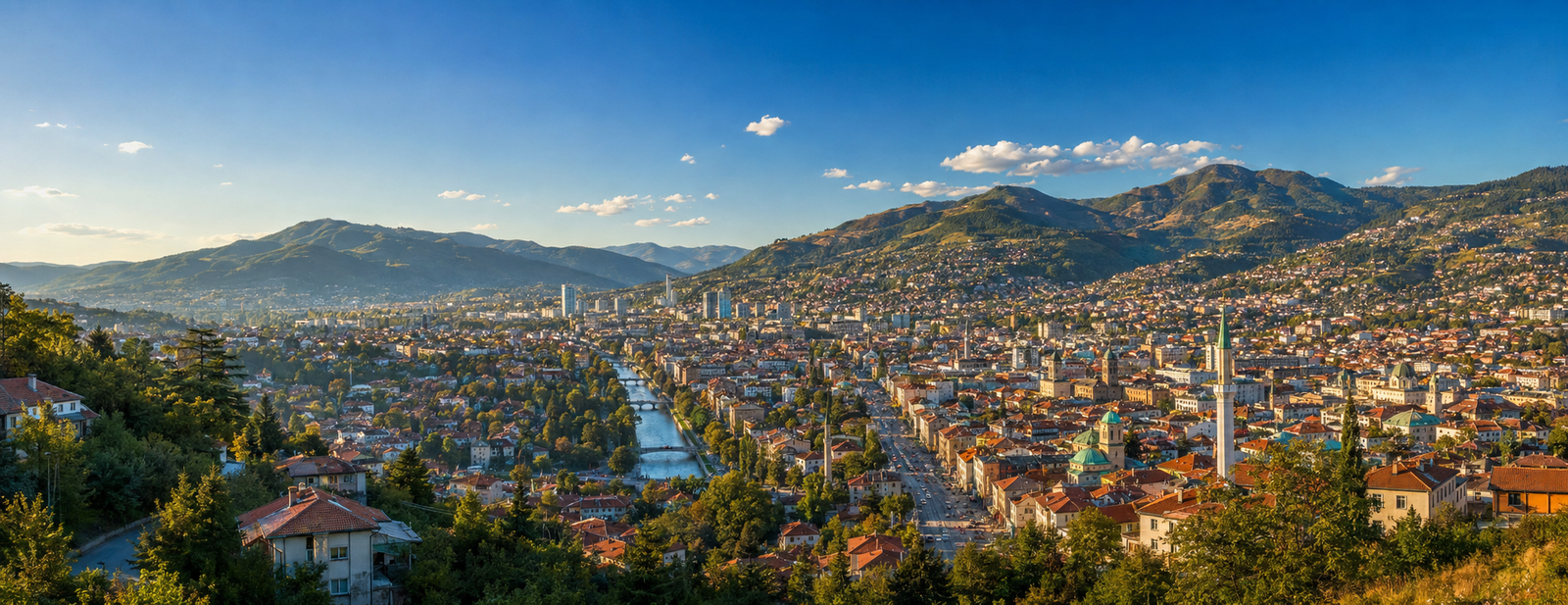
Sarajevo hands you an unusually simple weekend. The start line, the old town, the food and almost every hotel worth booking sit on a single strip along the river, twenty-five minutes end to end on foot. You will not need a taxi after the one from the airport.
It is also, as it happens, the same strip the race runs down — and the same one that was lethal to cross thirty years ago. This page covers all three: where to sleep on it, where to eat on it, and what it is you're actually walking through.
TWO ENDS OF THE SAME WALK.
Marijin Dvor at one end, Baščaršija at the other, twenty to twenty-five minutes apart. Anywhere on that line puts you close to both the start and the evenings, and central rooms run roughly £40–70 a night. The only real question is which you'd rather have on your doorstep: the start line, or the dinner.
MARIJIN DVOR
The modern centre, and where the race starts and finishes. Glass towers next to the old Parliament, wide boulevards, business hotels. It is not the prettiest part of Sarajevo, and on race morning that stops mattering entirely.
Best if you want to walk to the start in five minutes, sleep twenty minutes later, and not think about logistics at 07:00 on a Sunday.
BAŠČARŠIJA
The Ottoman old town: the copper-smiths' bazaar, the Sebilj fountain, the coffee houses, and every single place listed further down this page. It is where you'll actually want to be once the medal is on.
Best if you're making a proper city break of it and don't mind a twenty-minute walk to the start — which, as a warm-up, is arguably the correct way to do it anyway.
WHERE I'D ACTUALLY STAY.
This is the part of the guide I won't fake. Three places I'd genuinely book, not a dozen I've only read about on a booking site.
HOTEL HOLIDAY
On Zmaja od Bosne itself, about five minutes' walk from Marijin Dvor. Built for the 1984 Winter Olympics, and you can't beat the walk to the start line on race morning.
BOUTIQUE BRISTOL
Sits right on the Miljacka, a comfortable walk to both the start and the old town — a reasonable middle ground if you don't want to choose between race-morning convenience and evenings in Baščaršija.
HOTEL SOKAK
Tucked into Baščaršija itself, steps from the Gazi Husrev-beg Mosque and the Latin Bridge. Small — fourteen rooms — and quiet, on a street built for four different faiths within a few hundred metres of each other.
Three things worth getting right when you book: choose free cancellation, because your race entry is already non-refundable and you shouldn't have two things you can't undo. Check when breakfast opens — a hotel that starts serving at 08:00 is no use for an 08:30 start, so buy your pre-race food the night before. And have your flights settled first; if they aren't, start there instead.
THE STREETS you'll run on.
You should know what you are walking around, because the course does not hide it. Sarajevo was under siege from April 1992 to February 1996 — 1,425 days, the longest siege of a capital city in modern warfare, longer than Leningrad. The main boulevard the race starts on, Zmaja od Bosne and its continuation Meša Selimović Boulevard, was known during those years as Sniper Alley: crossing it could get you killed.
Thirty years later, several thousand people close it to traffic on a Sunday morning and run down it for no reason other than that they can. I am not going to dress that up. The fact is enough.
FOUR PLACES, and what each is for.
Sarajevo is a real food city and cheap with it. Rather than list twenty, here are four that cover the whole trip: breakfast, the ritual lunch, the dinner worth booking, and the coffee you sit over afterwards. All four are in or beside Baščaršija, within a few minutes of each other. Prices move, so I haven't invented any — but you would struggle to spend £15 a head at the first two.
BUREGDŽINICA SAČ
BurekThe one most people, locals included, will name first. It takes its name from the sač — the heavy bell-shaped lid the pastry is baked under, coals piled on top — and they run several at once, so the coil coming out is minutes old rather than sitting under a lamp. Order it with a yoghurt and eat it standing up like everyone else.
ĆEVABDŽINICA ŽELJO
ĆevapiThe busiest ćevapi in the city and the one the most people actually eat at — so popular it outgrew itself and now runs two branches facing each other across the same lane, which tells you most of what you need to know. Ten ćevapi in warm somun bread with raw onion and a dish of kajmak on the side. That's the whole menu, and it doesn't need another line.
INAT KUĆA
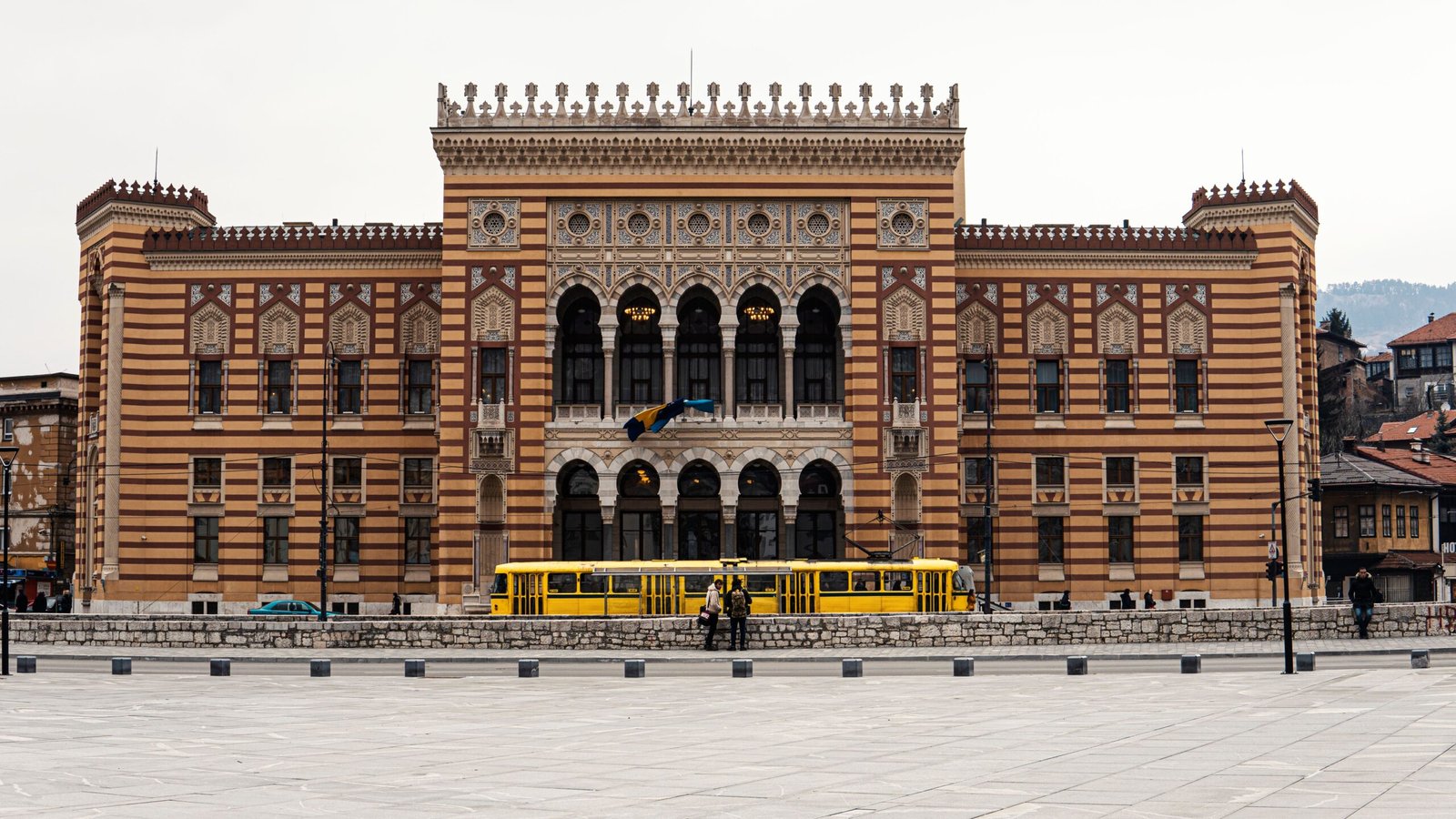
DinnerThe traditional Bosnian dinner, in a building with the best story in the city. When the Austro-Hungarians wanted to build the grand City Hall in the 1890s, one man — Benderija — refused to move. He finally sold in 1895 for a sack of gold ducats and on the condition that they dismantle his Ottoman house and rebuild it brick by brick on the far bank. He reportedly sat on the bridge smoking through the entire move, watching every brick cross. The house has been called Inat Kuća — the House of Spite ever since, and has been a restaurant since 1997.
Order the slow-cooked things: bosanski lonac, dolma, bamija. This is where the food stops being street food and starts being cooking.
RAHATLOOK
Coffee & sweetsWhere you sit down afterwards. Bosnian coffee arrives as a small copper džezva with a cup, a sugar cube and a square of rahat lokum, and it is meant to take half an hour — the closest thing this city has to a national instruction. Their sweets are the reason to pick this one over the dozen others: real butter and real cream where most places have quietly moved to margarine. The tufahija, a whole poached apple stuffed with walnuts, is the one to get.
THREE THINGS THAT CATCH BRITS OUT.
Burek means meat
Ask for burek and you get the meat one — that is the only thing the word means here, and getting it wrong is a small local sport. The cheese version is sirnica, potato is krompiruša, spinach is zeljanica. Order by name and you'll get what you wanted.
Coffee is not a takeaway
Bosnian coffee comes in a džezva to be poured slowly and drunk sitting down. There is no rushing it and nobody will hurry you out of the chair. Don't order one twenty minutes before you need to be somewhere.
Don't over-tip
Rounding up, or ten percent in a proper restaurant, is generous. London habits here read as slightly odd rather than generous — and given a full dinner costs less than a pint back home, the maths already favours you.
THE SHORT LIST.
What most first-timers want to see, and all of it comfortably inside a day and a half.
BAŠČARŠIJA & THE SEBILJ
The Ottoman bazaar and its wooden fountain — the heart of the old town, and where everything above happens.
THE LATIN BRIDGE
Where Franz Ferdinand was assassinated in 1914. A small stone bridge that set the twentieth century going.
CITY HALL (VIJEČNICA)
Burned during the siege, rebuilt and reopened. The same building Benderija refused to make way for — his house still stares at it from across the water.
THE TREBEVIĆ CABLE CAR
Up the mountain for the view back over the valley you just ran through. The best twenty minutes of the weekend.
The course itself runs the modern riverside city, not the old town — so all of this is for your evenings, not your splits.
Affiliate disclosure: this page contains affiliate links — Amazon, plus flight and accommodation searches through Travelpayouts and Stay22. If you book through them I may earn a small commission at no extra cost to you. No sponsorships, and it never changes what goes on this page.