Home  ›  Running  ›  How To Start Trail Running

Running · Beginner Guide

THE COMPLETE BEGINNER'S GUIDE
TO TRAIL RUNNING.

Everything you need to go from pavement — or from nothing — to confident off-road running. Why walking uphill is elite strategy, how to descend without destroying your legs for three days, why your road pace means nothing out here, and what you genuinely need before your first trail.

By Fit & Myth · 14 min read · Evidence-based

15%

Gradient where walking
beats running

6W

To trail-ready
fitness

2,500

Miles of National Trails
in England & Wales

£0

Extra cost for
your first easy trail

Before You Start

My first trail run was two minutes per kilometre slower than my slowest road run — and I finished it more tired, more muddy, and more certain I would do it again than any road session that year. Luna, for the record, decided within the first five minutes that trails are the only acceptable form of running.

This guide assumes nothing. If you can already run 20–30 minutes on road, you will move through it faster. If you are starting from zero, that is fine too — trail running is actually kinder to complete beginners than road, because walking is built into the sport at every level. Nobody on a trail can tell whether you are a beginner walking a hill or an ultrarunner walking the same hill. They are doing the same thing.

Section 01

FORGET YOUR PACE.
IT MEANS NOTHING HERE.

The first thing the trail takes from you is your pace — and it is the best thing that will happen to your running. On uneven ground, with climbs, mud, roots and gates, your GPS pace can drop by one to two minutes per kilometre while your effort stays exactly the same. Trail runners measure effort and time on feet, not minutes per kilometre. A hilly 40-minute trail run at conversational effort is worth the same as a 40-minute road run, whatever the watch says.

There is a physiological reason the trail feels different in your head, too. A 2015 Stanford study found that exercise in natural environments measurably reduced rumination — the repetitive negative thought loops linked to anxiety — compared with the same exercise in an urban setting. Research on so-called green exercise consistently shows lower perceived exertion and better post-exercise mood outdoors at identical intensities. The trail is not just a harder workout. It is a quieter one.

And it rebuilds your body differently. Every step on uneven ground is a micro-decision — where the foot lands, how the ankle loads, when the stride shortens. That constant variation trains proprioception, foot and ankle strength, and balance in a way no flat pavement can. You are never on autopilot.

Section 02 · The Structure

SIX WEEKS.
THREE TRAILS A WEEK.

Three sessions a week with a rest day between them, exactly like road. The difference: progression is measured in terrain and time on feet, not distance or pace. If a week feels too hard, repeat it — there is no penalty for taking eight weeks instead of six.

Starting from absolute zero? Run/walk the same plan: 60–90 second runs with walking recovery, on the same easy trails. The structure holds — only the running intervals shrink.

WEEK 01 Easy, flat, well-marked trail — country park or forest track 20–30 min · walk every uphill · learn the surface
WEEK 02 Same easy trails, add gentle rolling terrain 30 min · run/walk entirely by feel, not by watch
WEEK 03 Introduce short descents — practise small, quick steps 30–40 min · downhills at easy effort, never braking hard
WEEK 04 Longer continuous running between walk breaks 40–50 min · walk only the steepest climbs
WEEK 05 First mildly technical section — roots, rocks, narrow path 45–50 min · time on feet matters, distance does not
WEEK 06 A full hour on mixed trail, hiking the steep stuff 60 min · you are a trail runner. This was always the goal.

Your connective tissue — tendons, ligaments, the small stabilisers of the foot and ankle — adapts over weeks, not days. Research on trail running injuries shows the ankle is the single most commonly injured site, and almost all of it traces back to doing technical terrain before the ankles were ready. The six-week ramp exists for them, not for your lungs.

Section 03 · The Rule That Changes Everything

THE HILL DECIDES WHEN YOU WALK.
NOT YOUR EGO.

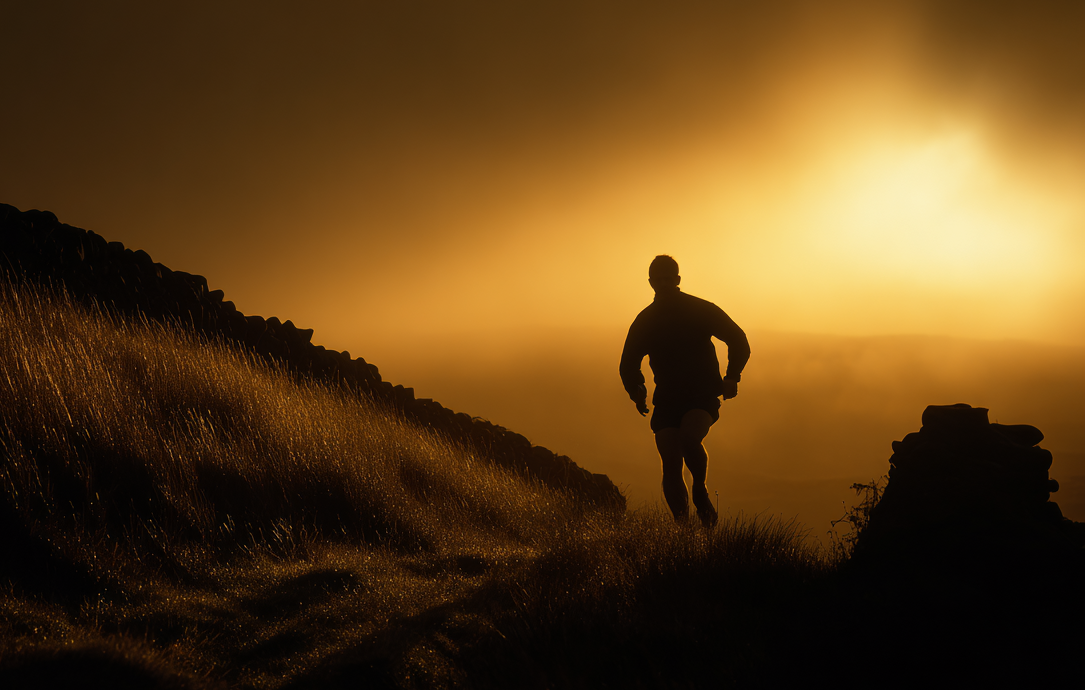
Walking uphill is not a beginner's compromise — it is the sport's core technique, used by every elite ultrarunner in the world. It even has a name: power hiking. Beyond roughly a 15% gradient, the energy cost of running a climb becomes unsustainable while your actual speed barely improves — walking moves you at almost the same pace for far less energy.

The technique: lean forward from the ankles, shorten your steps, keep the cadence high — and on steep pitches, press your hands onto your thighs just above the knee, using your arms as a second engine to offload the quads. Watch the front of any mountain ultra: the fastest runners on the steepest climbs are all walking, hard, hands on thighs. Now you know why.
Section 04

FIVE MISTAKES THAT END
TRAIL RUNNING EARLY.

01

RACING THE DOWNHILLS

Downhill running is eccentric loading — your quads lengthen under load, acting as brakes, which causes far more muscle micro-damage than flat or uphill running. That is why your legs hurt for three days after a hilly run. Short, quick steps, a slight lean down the slope, no hard braking — and the damage drops sharply. Bonus from the research: one careful downhill session protects your muscles from the next one for weeks. It is called the repeated bout effect.

02

JUDGING YOURSELF BY ROAD PACE

One to two minutes per kilometre slower is normal, expected, and permanent — the trail is simply harder ground. Beginners who chase their road pace on trails run too hard, hate it, and quit. Turn the pace screen off. Effort and time on feet are the only honest metrics out here.

03

STARTING ON TECHNICAL TERRAIN

Ankle sprains are the most common acute trail running injury — one review found nearly half of all trail injuries occur at the ankle. Almost all of them happen on terrain the runner was not ready for. Weeks one to four belong on forest tracks and country park paths. The rocky ridge line will still be there in month two.

04

TELLING NO ONE WHERE YOU ARE GOING

The trail's greatest feature — being away from everything — is also its only real risk. Before every run: someone knows your route and rough return time, your phone is charged, and your map is downloaded offline, because signal dies exactly where the trail gets good. OS Maps, Komoot or AllTrails all do this free.

05

UNDERESTIMATING THE DAY

A 10K trail can take double your 10K road time — and UK weather on exposed ground changes fast and without asking. Check the forecast for the trail, not for your town. Carry a packable waterproof from October to April. Start with loops that are easy to cut short, not out-and-backs that commit you to the full distance.

Section 05

WHAT YOU ACTUALLY
NEED TO START.

Trail running marketing sells wilderness expedition kit to people going for a 30-minute run in a country park. The genuinely required list is shorter than the road running one — because the one thing that matters most, knowing where you are and someone knowing where you are, is free.

TRAIL RUNNING SHOES — EVENTUALLY

Here is the honest version the industry will not tell you: for week one, on a dry forest track, your road running shoes are fine. Buy trail shoes when you commit — look for 4–5mm lugs for grip, a rock plate if your trails are stony, and a snugger fit than road shoes to stop the foot sliding on descents. Fit matters more than brand. Waterproof uppers are optional and divisive: in proper UK mud your feet get wet regardless, and non-waterproof shoes drain and dry faster.

A PHONE WITH OFFLINE MAPS

The single most important piece of trail safety kit, and you already own it. Download your route before leaving — OS Maps, Komoot and AllTrails all work offline for free. Tell one person where you are going and when you expect to be back. This 30-second habit is the entire difference between an adventure and an incident.

A PACKABLE WATERPROOF JACKET

Non-negotiable in the UK from October to April, and worth carrying on exposed routes all year. Under 200g, packs to fist size, lives in your pocket or waistband. Weather on open ground changes faster than weather in town — the jacket is for the forecast being wrong, which it will be.

WATER AND A SNACK — FROM WEEK 4

Under 45 minutes on a cool day, you need nothing. Once your runs pass the hour, carry 500ml and something to eat. A soft flask in a pocket works before you buy anything; if you fall for the sport — and you will — a running vest solves carrying forever.

WHAT YOU DO NOT NEED

Poles, gaiters, a hydration vest, a GPS watch, compression anything. All of it exists, some of it is genuinely useful at ultra distance, none of it changes whether your first six weeks succeed. The kit list for week one is: shoes you own, a charged phone, a jacket if it might rain, and a trail. That is the whole list.

Section 06

WHERE YOU ARE ALLOWED TO RUN.

The UK is one of the best countries in the world to start trail running, because of a legal quirk: public rights of way. Every public footpath and bridleway in England and Wales is legally open to you on foot — that is over 140,000 miles of trail, before you count the 15 National Trails (2,500 miles, and the best signposted paths in the country) or open access land in the national parks. In Scotland it is even simpler: the right to roam covers most open land.

Start with what is nearest: a country park, a nature reserve, a canal towpath that turns to gravel, the local woods. Familiar, forgiving, easy to cut short. The mountains are a season two problem — and they will still be there.
THE TRAIL IS ALREADY THERE. GO FIND IT.

Full Trail Running Guide →Back To Running Hub

Scroll to Top